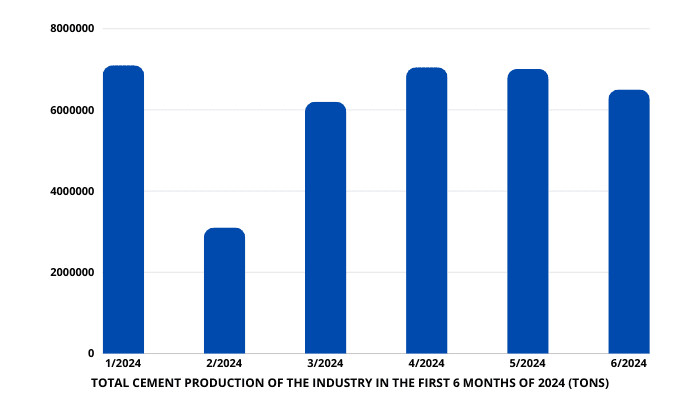
According to the Vietnam Cement Association, cement production in the first six months of this year is estimated to reach 44 million tons, unchanged from the same period last year. Currently, factories are operating at only 70 to 75% of their designed capacity, while inventory levels have surged to 5 million tons.
REGISTER TO RECEIVE THE DEMO REPORT FOR THE CEMENT INDUSTRY Q2/2024
Vietnam’s cement industry struggles with long-term losses
The Vietnamese cement sector is facing significant challenges related to consumption and costs, leading to forecasts of losses and potential bankruptcies for many companies.
Severe losses due to declining cement consumption
The current cement market is experiencing difficulties in product consumption. Despite a total designed capacity of 123 million tons per year, actual capacity may exceed this by tens of millions of tons. However, due to weak consumption, four newly-invested production lines have yet to commence operations.
Representatives from the Vietnam Cement Association assert that the industry has never faced challenges as severe as those present today. In 2023, 42 production lines had to halt operations for between 1 to 6 months, with some even ceasing operations for the entire year.
Source: ximang.vn
According to the Vietnam Cement Association, the industry is confronting considerable difficulties in production and consumption, risking the bankruptcy of numerous companies or forcing them to sell portions of their equity to foreign investors. The current period sees the cement sector under tremendous pressure, with weak domestic economic absorption capacity.
Domestic consumption remains very weak due to slow implementation of public investment projects, with infrastructure projects still relying on traditional technologies. Additionally, the housing market appears to be stagnant, with a low rate of actual implementation for social housing projects.
Moreover, external factors such as rising fuel and energy prices, particularly for coal, have further compounded the situation. Increased energy costs have led to higher transportation expenses, affecting both production costs and sales prices. As of January 1, 2023, the export tax on clinker increased from 5% to 10%, with no value-added tax benefits.
An increasing list of loss-making cement companies
The business indicators of the Vietnam Cement Industry Corporation (VICEM) in the first half of the year have not met expectations. The company’s clinker production reached 7.63 million tons, accounting for only 45.1% of its annual target and reflecting a 7.8% decrease compared to the same period in 2023. Cement production amounted to 9.77 million tons, equivalent to 45.4% of the plan, also down 7.2% from the previous year.
In this context, major companies such as Bim Son Cement, Vicem Hoang Mai, and Vicem But Son have set pessimistic profit forecasts for 2024, projecting losses of 159 billion VND, 104 billion VND, and 111 billion VND, respectively. Meanwhile, Quang Ninh Cement and Construction expects a 57% drop in profit, forecasting only 34 billion VND.
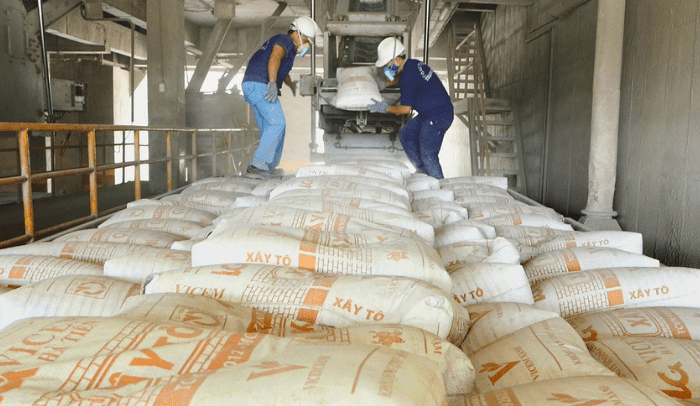
Vietnamese cement companies have been continuously reporting losses
Two other companies, Vicem Ha Tien and Sai Son Cement, appear more optimistic. Specifically, Vicem Ha Tien aims for after-tax profits exceeding 23 billion VND, a 31% increase, while Sai Son Cement targets over 11 billion VND, a 42% increase compared to 2023.
Previously, in an April report by the Hanoi Stock Exchange, several cement producers were found to be ineligible for margin trading. This includes Bim Son Cement Corporation, Vicem But Son Cement Corporation, Hai Phong Cement Trading, Service, and Transportation Company, and Vicem Hoang Mai Cement Corporation.
Continued challenges for cement exports
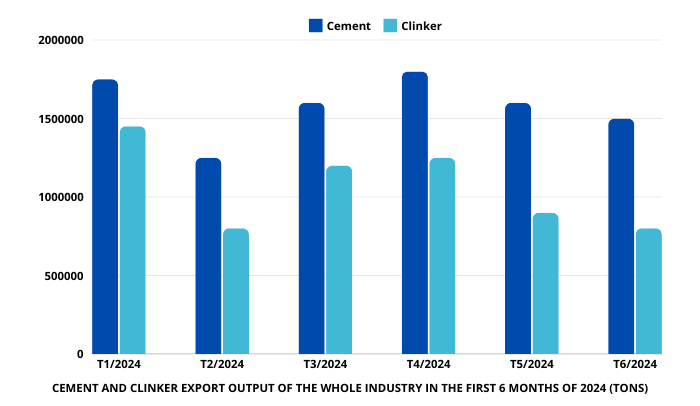
In addition to facing excess capacity and slow domestic consumption, the export of cement and clinker is also experiencing a severe decline.
Dramatic drop in clinker and cement exports
According to the Vietnam Cement Association, cement and clinker exports are forecasted to continue facing numerous challenges. The primary reason is the ongoing slump in the Chinese real estate market, coupled with an oversupply of cement. As a result, Vietnam is expected to face intense competition in markets such as the Philippines, Central America, and South Africa…
Source: ximang.vn
Furthermore, Vietnam has increased the export tax on clinker from 5% to 10%, diminishing the competitiveness of these products in the international market. Additionally, the Philippines has implemented anti-dumping duties on imported clinker and cement from Vietnam.
In this context, the Vietnam Cement Association has urged the government to present to the National Assembly a proposal to abolish the export tax on clinker to mitigate current difficulties. For now, the 5% export tax on clinker will be maintained until a formal decision is made.
Facing significant declines in export prices
According to the Ministry of Construction, the average price in 2022 was 46-48 USD/ton for clinker and 51-53 USD/ton for cement. By May 2024, prices had dropped to 31-32 USD/ton for clinker and 38-48 USD/ton for cement, while bulk cement prices fell to only 36-37 USD/ton.
This price drop marks one of the most adverse developments in the history of the cement industry. Factors leading to this situation include declining global demand, competition from suppliers, and ongoing changes in trade policies of importing countries.
The unstable economic situation has led to caution in spending from both governments and the private sector across many nations. Many large-scale construction projects have been suspended or canceled due to a lack of investment capital. Consequently, this has led to a decline in demand for clinker and cement, resulting in significant price drops for both products in the market.
Many large-scale construction projects have been halted or canceled due to a lack of investment capital, along with the cautious spending behavior of both governments and businesses amidst an unstable economic context. This directly affects the consumption of clinker and cement, leading to substantial price reductions.
Solutions to boost Vietnam’s cement industry
According to Nguyen Quang Cung, President of the Vietnam Cement Association, cement companies have not received significant support to maintain production and upgrade systems. It is essential to establish preferential policies to promote sustainable development, encourage the reuse of waste heat, save energy, and protect the environment.
To address financial issues in the cement industry, the Ministry of Construction has urged the Prime Minister and the State Bank to consider amending policies regarding debt rescheduling, debt deferral, and interest rate reductions for companies in the sector, aligning with their current financial capacities.
Dr. Le Trung Thanh, Director of the Building Materials Department (Ministry of Construction), stated that the Ministry is coordinating with other departments and the Vietnam Cement Association to increase capacity, reduce costs, and utilize industrial waste. The goal is to lower cement production costs, generate electricity from waste heat, and simultaneously protect the environment.
Specifically, the State Bank has amended Circular 02/2023/TT-NHNN, extending the debt repayment period to a maximum of 36 months from the due date of the adjusted debt. Additionally, the application period for this adjustment has been extended until December 31, 2025, allowing companies more time to restructure their debt repayment schedules.
Moreover, the Ministry of Construction has finalized and submitted to the government the revised Housing Law and Real Estate Business Law to promote sustainable market development and implement at least one million social housing units for workers from 2021 to 2030, thus stimulating cement consumption in the future.
REGISTER TO RECEIVE THE DEMO REPORT FOR THE CEMENT INDUSTRY Q2/2024
VIRAC also provides the Data Factory economic data system to help individuals access raw data. Data Factory VIRAC provides data for 456 industry codes with information: Number of enterprises; Number of employees; Net revenue; Fixed assets; Basic investment capital; Pre-tax profit; Taxes and obligations of economic sectors.
In addition, the advanced statistics of Data Factory VIRAC also provide data on production, consumption, and inventory of 1910 products by quarter, by province, and nationwide.
To learn more about VIRAC Data Factory, please send your information to our Zalo Official Account or scan the QR code below.

VIRAC was established by a team of reputable personnel with expertise in market research in the region. VIRAC specializes in providing products and services related to:
- Industry research
- Business Research
- Market research
- VIRACE data platform
Partners of VIRAC
- Vietnam Joint Stock Commercial Bank for Foreign Trade (Vietcombank)
- Vietnam Joint Stock Commercial Bank for Industry and Trade (Vietinbank)
- Vietnam Bank for Agriculture and Rural Development (Agribank)
- Military Commercial Joint Stock Bank (MB Bank)
- Unilever Vietnam International Company Limited
- Olam International
- FrieslandCampina