Vietnam’s wood industry has recorded noticeable growth in 2024 compared to the previous year. However, increasingly stringent export regulations in major markets have made it challenging for the industry to achieve the goals set at the beginning of the year.
Compared to the growth observed earlier in the year, the wood industry experienced a slowdown by mid-year, as order volumes for enterprises showed little growth compared to the previous year.
REGISTER TO RECEIVE VIETNAM’S WOOD INDUSTRY REPORT IN Q3/2024
Vietnam’s wood industry exports struggle to meet 2024 targets
In 2024, Vietnam’s wood industry is facing significant challenges, making the export target of $17.5 billion difficult to achieve. Current order volumes for enterprises in the sector are only at levels similar to or slightly higher than those in 2023, but still fall short of 2022, when wood and wood product exports reached a record $15.8 billion.
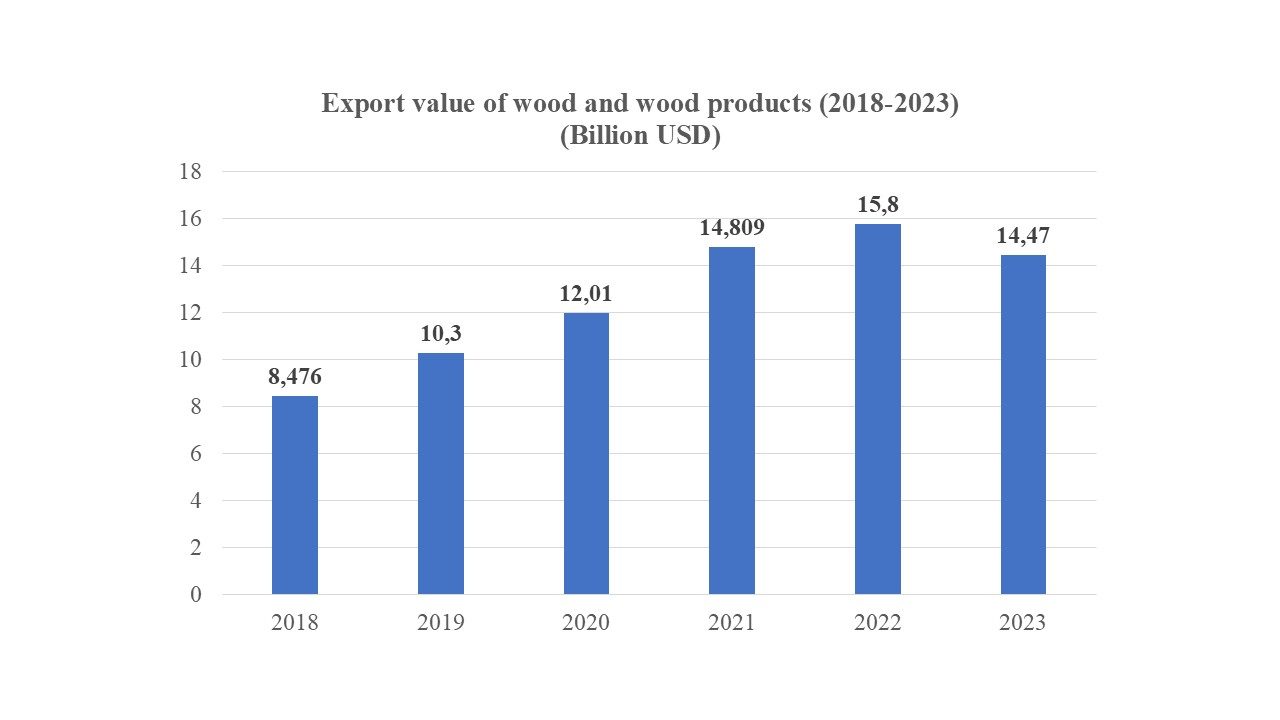
Export value of wood and wood products (2018-2023)
In the first eight months of the year, exports of wood and wood products reached $10.24 billion, an increase of 20.6% compared to the same period last year.
Despite this growth, achieving an additional $5 billion in the remaining months presents a significant challenge as international demand remains highly unpredictable.
Challenges for Vietnam’s wood industry in international markets
Vietnam’s wood industry faces numerous barriers in international markets as major markets are increasingly tightening regulations on export goods.
Vietnam’s wood exports in international markets
Key export markets such as the United States, China, and Japan continue to play a pivotal role in Vietnam’s wood export value. By the end of July, exports to the United States reached nearly $4.9 billion, accounting for approximately 55% of total export turnover, with an impressive growth rate of 26% compared to the same period last year.

Proportion of Vietnam’s Wood Exports to Key Markets by the End of July 2024
(Source: Baocongthuong)
The Chinese market ranks second, with an export value of $1.2 billion, a significant increase of 39.1%, accounting for 13.5% of total export turnover. Japan accounted for 10.8%, with $961.3 million, a slight increase of 1.5% compared to the previous year.
Challenges amid stricter market requirements
Vietnam’s wood industry is facing significant challenges as it navigates increasingly stringent international regulations. The U.S. Lacey Act and anti-deforestation requirements demand businesses to prove the legal origin of wood, resulting in higher costs and complex procedures, which place considerable pressure on wood exporters.
In addition to the U.S., Europe has implemented a carbon border adjustment mechanism, requiring businesses to provide information on production processes and emissions.
This presents a substantial challenge for Vietnam’s wood industry, particularly for small and medium enterprises. The cost of complying with environmental regulations can increase production costs, reducing competitiveness.
High shipping costs continue to impact Vietnam’s wood export expenses. Businesses face a sharp rise in logistics costs, significantly affecting profit margins.
Additionally, the price of imported wood materials has risen considerably, particularly from African and South American countries, further squeezing profit margins.
Domestic market: Development opportunities for Vietnam’s wood industry
Vietnam’s domestic market is presenting significant opportunities for the wood industry, with an estimated size of $10 billion. With a population of approximately 100 million and a rapidly growing middle class, the demand for furniture and wood products is on the rise.
According to the Vietnam Timber and Forest Product Association, tapping into the domestic market will help businesses reduce dependence on exports while building a solid foundation for domestic growth.
Currently, about 90% of high-end furniture in the domestic market is imported, primarily from European countries and Japan. This indicates substantial potential for the development of local brands if businesses focus more on quality and designs that cater to domestic preferences.
REGISTER TO RECEIVE VIETNAM’S WOOD INDUSTRY REPORT IN Q3/2024
VIRAC also provides the Data Factory economic data system to help individuals access raw data. Data Factory VIRAC provides data for 456 industry codes with information: Number of enterprises; Number of employees; Net revenue; Fixed assets; Basic investment capital; Pre-tax profit; Taxes and obligations of economic sectors.
In addition, the advanced statistics of Data Factory VIRAC also provide data on production, consumption, and inventory of 1910 products by quarter, by province, and nationwide.
To learn more about VIRAC Data Factory, please send your information to our Zalo Official Account or scan the QR code below.

VIRAC was established by a team of reputable personnel with expertise in market research in the region. VIRAC specializes in providing products and services related to:
- Industry research
- Business Research
- Market research
- VIRACE data platform
Partners of VIRAC
- Vietnam Joint Stock Commercial Bank for Foreign Trade (Vietcombank)
- Vietnam Joint Stock Commercial Bank for Industry and Trade (Vietinbank)
- Vietnam Bank for Agriculture and Rural Development (Agribank)
- Military Commercial Joint Stock Bank (MB Bank)
- Unilever Vietnam International Company Limited
- Olam International
- FrieslandCampina